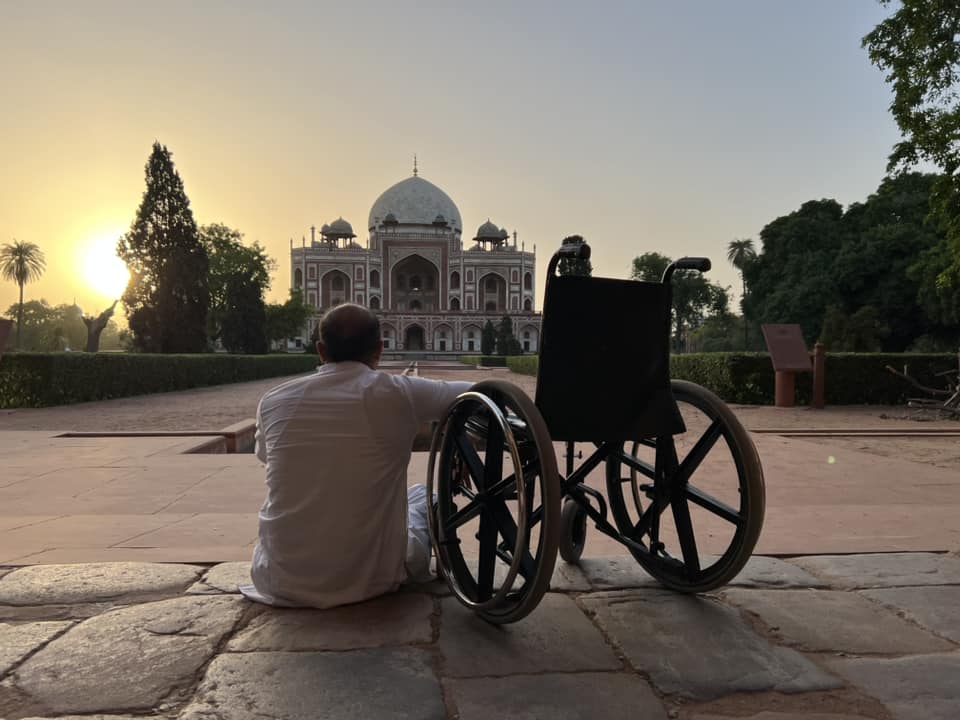
Photo by We the Disabled People of India on Flickr/Husnain Weareone on Facebook
By Susan Job, Communications Associate, Pacta
Disability non-profit organisations (NPOs) in India fill important gaps in government programmes through grassroots implementation and community-based support, helping translate rights and policy commitments into lived realities for persons with disabilities.
Approximately 68,724 non-profits in India work across the disability sector, constituting 10% of the country’s entire registered non-profit ecosystem. Their work spans education, livelihoods, rehabilitation, accessibility, advocacy, and community-based support for persons with disabilities. Despite this substantial footprint, disability remains one of the most under-resourced areas of social investment. Corporate Social Responsibility (CSR) funding for disability is estimated at only 1% of total CSR spending, while India’s combined Union Government and state disability budgets amount to a mere 0.04% of the total GDP.
The disparity is not solely a question of funding volume. It also reflects how funding reaches the sector, the forms it takes, and the extent to which it supports the long-term sustainability and organisational development of disability non-profit organisations.
At Pacta, we examined this through The Landscape of Funding for Disability in India, drawing on interviews with ~15 funders, focus group discussions with 26 disability non-profits, surveys with 52 disability non-profits, and secondary data analysis. The findings point to a sector with substantial experience and deep community engagement, yet one that continues to operate within funding structures that can constrain long-term organisational resilience.
Funding fragility persists
Disability NPOs access funding from a range of sources, including CSR programmes, philanthropic foundations, foreign donors, government grants, high-net-worth individuals, and individual contributors. Organisational age and scale influence both the number and diversity of these funding relationships.
Among the 52 disability NPOs surveyed, funding diversification is more visible among mature organisations with larger annual budgets. The survey indicates a broad progression toward higher annual budgets with organisational maturity, although age does not uniformly translate into financial scale. Organisations in the lowest budget categories rely heavily on individual donors and self-generated revenue, with limited access to institutional funding. For organisations (7 NPOs) with annual budgets below ₹10 lakh (approximately USD 12,000), 86% reported funding from individual donors, while only 29% reported CSR support and 14% reported foreign funding. By contrast, organisations (12 NPOs) with annual budgets above ₹5 crore (approximately USSD 600,000) reported a broader funding mix: 100% reported CSR and individual donor funding, 92% reported foreign funding, and 75% reported philanthropic foundation funding. This suggests that older NPOs operating on a larger scale are better positioned to access diversified funding portfolios.
However, access to a broader mix of funders does not necessarily translate into greater funding flexibility. Grant flexibility remains constrained across the sector and does not appear to improve with organisational maturity. Of the organisations (19 NPOs) operating for more than 30 years, 95% reported restricted funding, while only 5% reported access to fully unrestricted support. Financial reserves, including corpus funds, remain limited across the sector. Only 37% of surveyed disability NPOs reported having such reserves. For organisations(12 NPOs) with annual budgets above ₹5 crore (approximately USD 600,000), this figure stood at 58%.
These patterns directly affect the long-term resilience of the NPOs. Without flexible capital or financial reserves, organisations have limited room to invest in leadership development, governance systems, fundraising functions, organisational planning, monitoring and evaluation, and impact measurement. Yet these investments often sit outside programme budgets, despite their importance to organisational resilience and long-term effectiveness. These constraints highlight the importance of philanthropy’s funding approach, particularly the extent to which it supports organisational capacity, long-term relationships, and flexible forms of capital.
The role of trust-based philanthropy in better funding for disability
Philanthropic funding in India is shaped by three dominant decision-making logics:
- Trust-based funding (relationship-driven)
- Impact-based funding (evidence-driven)
- Compliance-based funding (checklist-driven)
Across these models, funders commonly look for alignment with strategic priorities, measurable impact, scalable programmes, diversified funding, strong governance, financial prudence, and compliance capacity. This is compounded by limited donor interest in disability work (73%), a lack of donor understanding of the disability space (62%), and donor unwillingness to fund organisational development (37%), as reported by surveyed organisations. While funder criteria appear rational in seeking accountability for funds disbursed, they create a central mismatch for disability NPOs: the outcomes funders seek often require time, institutional capacity, and sustained engagement that short-term, programme-restricted funding does not adequately support.
Survey data shows how closely funder expectations overlap with areas where disability NPOs face capacity constraints. While funders seek measurable outcomes, 96% of surveyed organisations reported difficulty demonstrating impact. While funders value diversified funding, 67% reported limited donor access, and 23% reported limited information on donor trends and strategies. Nearly half reported donor preference for short-term funding, while 44% reported limited specialised fundraising staff.
The mismatch is acute because disability-focused outcomes often emerge over extended periods. Greater independence, access to education and employment, community participation, and improved quality of life often emerge over extended periods and require sustained engagement with persons with disabilities, families, employers, educational institutions, service providers, and public systems. Progress is frequently non-linear and influenced by factors beyond any single intervention.
Disability NPOs need leadership, governance, strategic planning, fundraising, monitoring and evaluation, financial management, and communications to sustain complex, community-based work and strengthen their ability to raise funds. Yet these capacities remain underfunded because available grants largely support specific activities, outputs, and reporting requirements.
The pressure is particularly visible in CSR grants, where annual cycles and documentation requirements can limit the space for experimentation and institution-building. Impact-based funding can also be difficult when expectations for evidence precede the investment needed to build monitoring systems, generate data, or test emerging models.
Trust-based philanthropy offers one way to break the pattern of low funding for disability. As catalytic risk capital, it can support organisations in testing ideas, strengthening internal systems, building evidence, and investing in work that may not yet meet the scale or documentation requirements of impact-oriented funding. Its value lies not only in supporting programmes, but also in financing common infrastructure, organisational capacity, research and development, and advocacy that enable disability NPOs to sustain and deepen their work over time. Trust-based philanthropy can also help embed disability inclusion within existing philanthropic portfolios, rather than leaving disability to depend only on dedicated or standalone funding streams.
Positioning disability within trust-based philanthropy
India’s disability sector draws on decades of institutional experience, community knowledge, and sustained engagement across service delivery, advocacy, accessibility, and inclusion. What remains fragmented is not the expertise within the sector, but the funding architecture around it.
Much of this fragmentation stems from how disability is often positioned within philanthropy: siloed as a standalone programme area, rather than as a cross-cutting lens embedded within broader development priorities. Integrating disability into better-resourced sectors such as education, healthcare, livelihoods, gender, rural development, and poverty reduction can help ensure that wider social investments also reach persons with disabilities.
Non-profits, too, have a role to play in breaking free of the low-disability equilibrium – they must find ways to explore collaborative programmes rather than reinvent the wheel each time and compete for funding. Non-profits must invest in clearly framing and communicating their impact early on, as well as in mechanisms that help build and sustain strong donor relationships.

Susan Job is a Communications Associate at Pacta, a Bengaluru-based law firm and think tank working to bridge the gaps between the intent and implementation of laws and policies. She holds a Master’s degree in Development from Azim Premji University, India. At Pacta, she works at the intersection of research communications and dissemination.