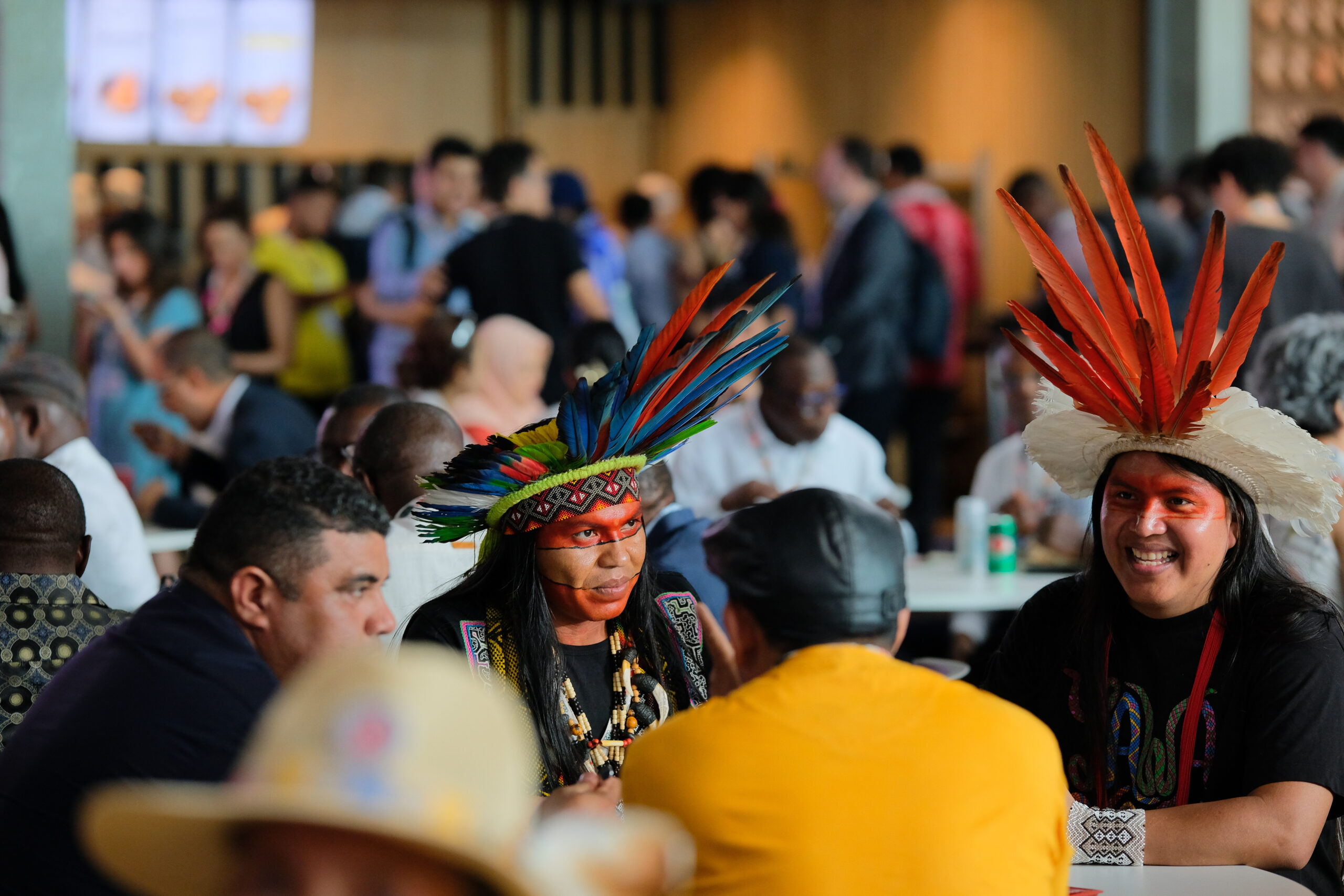
Photo by UN Climate Change – Diego Herculano
By Erika Miller, Head of Climate at WINGS
As I landed in Belém, I felt the weight of two competing worlds meeting. To my left: the dense, uninterrupted green of the Amazon — a living system fighting to stay alive. To my right: a city rising from the river’s edge, concrete pressed against ancient mango trees, where millions live in modern relationships with the forest.
From above, climate change stops being an abstract concept. You see how closely people and nature are intertwined, and how quickly both are being reshaped. COP30 forced global climate governance, philanthropy, and all of us to look the Amazon in the eye. Not as an abstract biome, but as a vibrant home already suffering the impacts of climate breakdown, from extreme droughts and forest fires to rising tides and shifting ecosystems that are eroding the ecological balance communities depend on.
And one thought was piercing through all others: Climate change is not just another issue area. It is the context within which every development goal must be pursued.
During my time in Belém, three distinct spaces shaped my reflections — spaces that rarely meet, yet must if we are serious about safeguarding the future of our planet: territory, finance, and climate governance.
Philanthropy’s role is to weave these worlds together — ensuring that community realities inform global decisions and that global commitments lead to urgent and just impacts that reach the ground.
1. Marajó Resiliente: Where Climate Change Is Already Reshaping Lives
I began COP30 in the territory — three days with the Quilombola communities of Marajó and a diverse group of philanthropic, multilateral, and civil society partners, on a visit to the Marajó Resiliente agroforestry project organised by Fundación Avina. Starting COP in this way was grounding. It reminded me how much this work matters.
In Marajó, climate change is not a distant notion — it is a lived experience by all the Marajoaras. Community leaders described rising tides that swallow land unpredictably, disappearing mangroves, shrinking shrimp, shifting fish patterns, and agricultural calendars that no longer align with their traditional knowledge passed down for centuries, forcing them to adapt their livelihoods.
But they also showed us how they are adapting and resisting — creatively, collectively, and with fierce determination. I learned that some communities have been displaced more than five times, yet continue fighting to stay on their land. Their struggle is not only against climate impacts, but against the systems that continue failing to protect them.
And this is where the Marajó Resiliente partnership stood out: a collaboration between public, private, philanthropic actors, and the people themselves — each contributing to an effort that began with one leader and one donor opening a door, then others joining, eventually unlocking larger institutional flows and leveraging supportive policies. It is a model of how the architecture for resilience is built: piece by piece, actor by actor.
Valéria Carneiro, from Malungu and the Quilombola Fund Mzizi Dudu, offered words that stayed with me:
“It is not just resource that moves our web,
It is the trust that weaves the steady net.
It is the wisdom from the forest and the river’s edge,
It is the future we plant, a future we don’t dread.”
In Marajó, philanthropy’s role as an enabler was unmistakable. It is more than just our sector’s resources that make an impact, but our ability to catalyse other resources, to be flexible and adaptable, to take risks, to convene diverse actors, and ultimately our ability to shift power to local communities.
2. The Global South House: Funding Approaches That Should Guide Climate Governance
The Global South House was the perfect segue from my time in Marajo back to Belem for the official start of COP30.
This space, hosted by Alianza Fondos del Sur and Rede Comuá, was created to centre diverse philanthropic voices from the Global South to “influence resource flows and power dynamics in favour of socio-environmental justice.” Walking into the House felt like entering a different kind of COP – one where governance was grounded in community leadership rather than high-level abstraction.
Over seven days of programming, sessions and events highlighted how philanthropic funds centre and amplify the power of Indigenous, Afro-descendant, and local communities leading climate action, and the profound impact these practices have had around the world.
Lisa Chamberlain, of the Environmental Justice Fund, clearly states what differentiates Global South funds from most traditional philanthropic approaches:
- They are proximate — deeply rooted and embedded in the communities they serve;
- They are representative — with governance led by the communities;
- They are adaptable — shifting as crises unfold and new realities emerge.
This is what climate governance must learn to become in order to implement the commitments they make behind closed doors, separated from the people these commitments are meant to serve.
Seeing the breadth of philanthropic organisations represented in the Global South House also reinforced a key insight from our ongoing Pan Amazon Climate Philanthropy Ecosystem Mapping: across the Amazon initiative, there is a diverse ecosystem of local funds with deep territorial credibility and significant absorptive capacity to channel much more — and much better — climate resources to the ground. Strengthening this ecosystem means increasing the visibility of these actors and the connectivity between them, so that locally led climate action can be resourced at scale.
While collaboration between funders and frontline communities emerged as crucial, Joelson Ferreira of Assentamento Terra Vista captured an important truth when he said: “This work is collective, but it is also individual. Each of us must change our mindset.”
His comment stayed with me. It points to how transformation in our sector begins with individuals, especially those in decision-making roles, and that the work required is not only technical, but personal. We must work to change the hearts and minds of people in this sector to unlock large-scale change. This same idea guides our Philanthropy Transformation Initiative, which aims to shift mindsets and practices, recognising that this transformation occurs at the individual, relational, organisational, and field levels. We all need to recognise our power and agency to act and influence.
3. Philanthropy Panel at COP30
By the time we reached our WINGS high-level philanthropy event with the COP30 Presidency and other sector partners, the only philanthropy-specific session on the official UNFCCC programme, the through-line between these spaces was evident. The urgent action we saw in Marajó, and the leadership demonstrated in the Global South House, are the same forces global climate governance is struggling to integrate. As Noura Hamladji, Deputy Executive Secretary of the UNFCCC, reminded us in her opening keynote: we are past the phase of ideas and commitments — this is the COP of implementation.
She was clear that delivering on the Paris Agreement requires partnerships at a level we have not yet mobilised, because no actor — not governments, not multilaterals, not philanthropy — can deliver the speed or depth the moment demands. But philanthropy can help unlock that speed by doing what others often cannot: bringing flexibility, long-term commitment, catalytic support, and the ability to operate where bureaucracy slows or blocks action. Noura stressed the need for predictable, multi-year support — the kind that allows communities, coalitions, and institutions to plan for the long haul rather than react in short cycles.
Across our expert panel, female leaders demonstrated what collaborative people-centred philanthropic action looks like in practice.
Maria Gracia of Fundación Avina showed how public–private–philanthropic–people partnerships can change the very conditions under which decisions are made. Lisa of the Environmental Justice Fund reminded us that locally led action and scale are not competing agendas, but mutually reinforcing when governance begins with the communities themselves. Ana Maria of the Gates Foundation championed investing in innovation and long-term capacity building to help ensure that work continues long after any grant ends. From China, Zhiyao from the SEE Foundation illustrated how storytelling, dialogue, and collaboration can mobilise new actors into climate philanthropy, while Sarah Millar at the Climate Emergency Collaboration Group underscored the urgent need for flexible support in adaptation and loss and damage, and the importance of funding negotiators from the Global South so that these agenda items are represented in the governance process. Anthea from the Caribbean Philanthropy Alliance brought us into the realities of small island states facing debt and vulnerability, where philanthropy is not peripheral but essential to building an ecosystem for resilience. And Fernanda of BNDES reminded us that partnerships with philanthropy allow public institutions to reach community organisations that bureaucracy alienates, especially in the Amazon.
What these perspectives revealed is that philanthropy’s contribution to climate action cannot just be financial; it must be structural. It is about helping to align actors, fill coordination gaps, leverage risk capital, pilot ideas, invest in research and ensure that the people closest to climate impacts are not the furthest from climate decisions. Philanthropy is not here to replace public action; it is here to strengthen the connective tissue that real implementation requires.
Conclusion
Over the course of my 12 days in Belém, I witnessed numerous examples of how philanthropy is helping drive implementation — not in isolation, but by strengthening the partnerships, ecosystems, and leadership that make climate action a reality. I also had the chance to share stories from the global Philanthropy For Climate movement, now more than 950 foundations strong, all recognising that integrating a climate lens is essential to achieving their wider missions.
What became overwhelmingly clear is that implementation will not come from the top down. It will only happen when what is lived in territories meaningfully informs what is decided in negotiation rooms. And philanthropy is uniquely positioned to help make that connection possible. COP30 also highlighted the actors who are already leading: Indigenous peoples, local communities, feminist leaders, youth, and Global South funds, whose knowledge and governance models are indispensable for any climate pathway that hopes to succeed.
While negotiators delivered a breakthrough on adaptation finance — a long-overdue recognition of the scale and urgency of climate impacts — they fell short on the transformational commitment needed to transition away from fossil fuels. This gap underscores an important truth: global agreements can signal direction, but they cannot carry action alone.
Philanthropy must continue to play a bridging role — supporting locally rooted leadership, funding coordination and capacity, resourcing Global South negotiators, increasing support for adaptation and loss and damage, and ensuring that climate action remains grounded in justice. If Belém taught us anything, it is that implementation depends on our ability to connect what is lived on the ground with what is decided globally — and philanthropy is uniquely positioned to help build those bridges.Through the Philanthropy For Climate movement, WINGS is helping create a shared framework that enables foundations everywhere to take meaningful climate action, including influencing and engaging governance spaces. The recent Baku to Belém Roadmap to 1.5°C reflects a growing recognition of philanthropy’s role — a recognition shaped directly by our sector’s collaboration and commitment throughout this process. Our task now is to carry this momentum forward and ensure that convenings like COP30 become catalysts for year-round, collective action.
We must work together to unlock even more resources to protect and save the Amazon biome. You can find the early results of our Pan Amazon Climate Philanthropy Mapping here. To stay informed and to get involved in the next steps of the initiative, please contact Erika Miller, Head of Climate at WINGS, at emiller@wingsweb.org.
To get first access to our blogs every month, subscribe to our newsletter here.